
Understanding Dengue !

Updated: Sep 10
Why the period around defervescence deserves special attention
When a child with dengue has been running a high fever for several days, parents naturally feel relieved when the temperature finally comes down.
But there is an important message that every parent should know:
In dengue, the fever coming down does not always mean that the danger has passed.
In some patients, the period when the fever settles—known as defervescence—marks the beginning of the critical phase of dengue. This is the time when careful observation becomes particularly important.

Understanding the three phases of dengue
Dengue typically follows three clinical phases:
Febrile phase
Critical phase
Recovery phase
The febrile phase usually lasts around 2–7 days. During this period, the child may have high fever, headache, pain behind the eyes, body aches, nausea, vomiting or rash.
For most patients, the illness remains uncomplicated and recovery follows.
However, in some patients, as the fever begins to settle—often around the 3rd to 7th day of illness—the disease can enter its critical phase. The critical phase typically lasts approximately 24–48 hours.
Why can the fever falling be a dangerous period?
The important complication during the critical phase is increased capillary permeability.
In simple terms, the blood vessels can temporarily become more permeable, allowing plasma, the fluid component of blood, to leak into surrounding tissues.
If the leakage is significant, the circulating blood volume can fall. This may result in:
Fluid accumulation around the lungs or abdomen
Reduced circulation
Low blood pressure
Dengue shock
Severe bleeding or organ involvement in severe cases
The concerning feature is that a child may sometimes look better initially because the fever has disappeared, while the underlying process is actually progressing.
Severe dengue can develop rapidly, sometimes within hours, which is why the critical period should not be taken lightly.
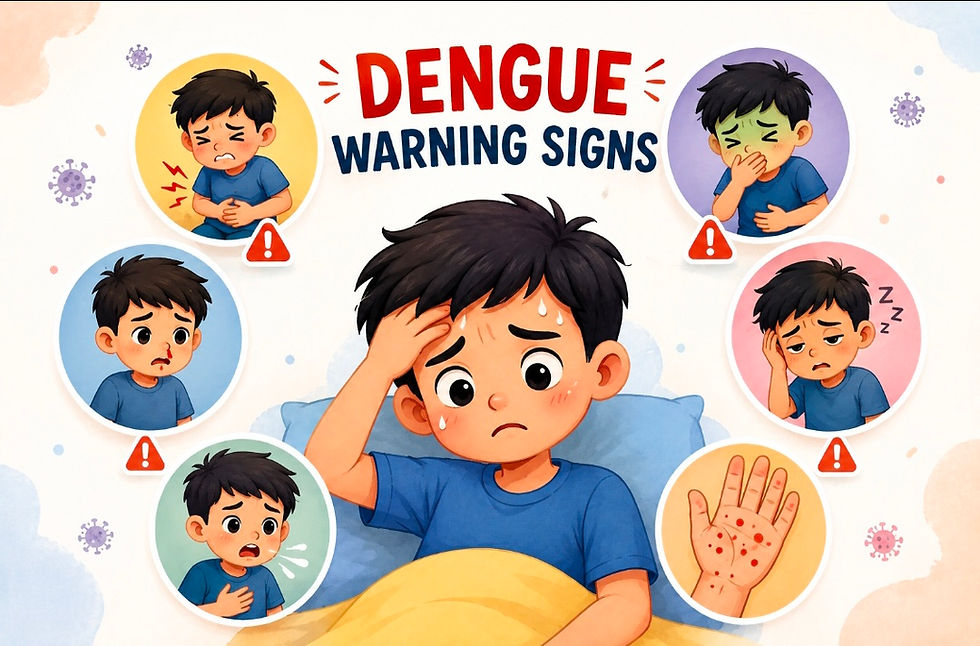
What should parents watch for?
A child who becomes afebrile should continue to be observed carefully, particularly during the following 24–48 hours.
Parents should seek prompt medical attention if any of the following warning signs appear:
• Severe or persistent abdominal pain
Significant abdominal pain or tenderness is an important warning sign and should not simply be attributed to "gas" or poor appetite.
• Persistent vomiting
Repeated vomiting can worsen dehydration and may also be a warning sign of progression.
• Bleeding
Watch for bleeding from the nose or gums, blood in vomit or stool, or other unusual bleeding.
• Increasing drowsiness, lethargy or restlessness
A child who becomes unusually sleepy, weak, irritable, restless or difficult to engage deserves medical assessment.
• Rapid or difficult breathing
This can occur with significant fluid accumulation or circulatory compromise.
• Cold, pale or clammy extremities
These may indicate impaired circulation and require urgent evaluation.
• Reduced urine output
A significant reduction in urine production can be an important indicator of inadequate circulation or dehydration.
These warning signs are particularly important around the time the fever settles.
What about the platelet count?
One of the most common concerns among families dealing with dengue is the platelet count.
A falling platelet count can occur during dengue and is an important laboratory finding. However, the platelet count should never be interpreted in isolation.
A child with a low platelet count but who is clinically stable may not necessarily have severe dengue. Conversely, a child can deteriorate because of plasma leakage and circulatory compromise even before the platelet count reaches an extremely low level.
Doctors therefore assess the overall clinical picture, including hydration, blood pressure and pulse, urine output, haematocrit, platelet trend, warning signs and other relevant investigations.
The trend and clinical condition are often more informative than a single platelet number.

What should parents do during this period?
For a child with uncomplicated dengue being managed at home, the most important principles are:
Maintain adequate oral fluid intake, as advised by the treating doctor.
Allow adequate rest.
Monitor the child's general behaviour and activity.
Keep track of urine output.
Watch particularly carefully when the fever starts to settle.
Follow the doctor's advice regarding blood tests and follow-up.
Use paracetamol/acetaminophen for fever when appropriate.
Avoid aspirin and NSAIDs such as ibuprofen because of the potential bleeding risk.
At the same time, do not force excessive fluids. Dengue management requires a balance: inadequate fluid replacement can be dangerous, but excessive intravenous or oral fluid administration, particularly during the recovery phase, can also cause complications. Fluid management should therefore be guided by the child's clinical condition and medical advice.
When does recovery begin?
If the child successfully passes through the critical phase without significant plasma leakage or other complications, the recovery phase begins.
During recovery, the leaked fluid is gradually reabsorbed into the circulation. Appetite and general well-being improve, urine output increases and the child gradually returns to normal.
Interestingly, the platelet count may begin to recover after other clinical signs have already started improving. Therefore, parents should not judge recovery solely by the platelet count.
The most important message for parents
Dengue can be deceptive.
A child may have several days of high fever and appear quite unwell. Then the fever suddenly disappears—and everyone assumes that recovery has started.
Sometimes it has. But sometimes this is exactly when the critical phase begins.
That is why the 24–48 hours around defervescence deserve particular attention.
Remember:
In dengue, fever coming down is a milestone—not necessarily the finish line.
If warning signs develop, do not wait for the next blood test or for the platelet count to fall further. Seek immediate medical evaluation.
Early recognition of deterioration and timely supportive treatment can make a critical difference in preventing severe dengue from becoming life-threatening.
For parents to remember:
Fever Down ≠ Danger Over
Watch carefully for the next 24–48 hours.
Dr Neerupam Gupta


Comments